Sara Goldfarb's stimulant-induced psychosis
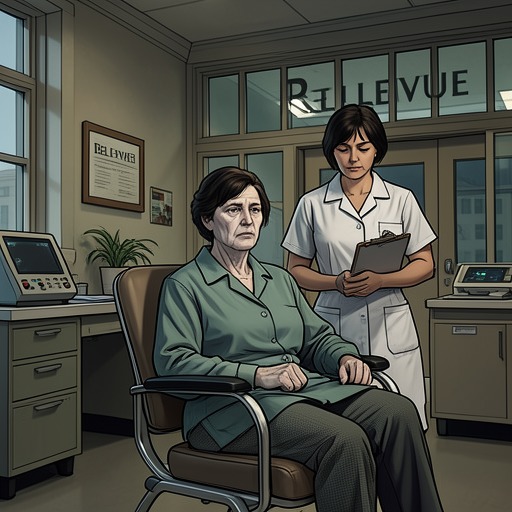
Requiem for a DreamSara Goldfarb’s stimulant-induced psychosis transforms her television dream from a promise of recognition into a frightening world that seems to expose and persecute her. As she takes more diet pills and drinks coffee to sustain the expectation of appearing on television, bodily distress, imagined broadcasts, and suspicion increasingly overwhelm the distinction between the screen and her apartment. The consequences extend beyond private delusion: Sara’s attempt to leave home for help ends in medical dismissal, and her eventual hospitalization subjects her to restraint, forced feeding, and shock treatment.
The Television Dream and Its Emotional Ground
Before her crisis peaks, Sara’s television is both an object she struggles to keep and a source of scripts for the life she wants. After her son, Harry Goldfarb, has the set taken away, she pays Abe Rabinowitz three dollars toward its redemption. Abe’s small ledger, titled SARA GOLDFARB’S TV, records years of payments and repeated returns of the set. He urges her to tell the police that Harry keeps taking it, but she refuses: Harry is her only child and relative, and she imagines him growing up, settling down with a nice Jewish girl, and giving her grandchildren. Her attachment to the television is bound up with her attachment to him and with the future she hopes he will have.
Once the set is back, Sara watches commercials and soap-opera scenes as if their domestic happiness were available to her. She studies images of clean houses, smiling couples, and food, and takes pleasure in the idea that a thin boy in an advertisement should have more meat on his bones, like Harry. She even forgoes lunch to afford the television. The set supplies an apparently reassuring pattern: a worried mother, a doctor, a decision, and a child who will recover. Sara anticipates a happy ending and uses it to reassure herself that Harry, too, is a good boy and that everything will turn out well. That habit of treating televised stories as guarantees helps explain why the later fantasy of appearing on television feels less like make-believe than a future she can already see.
Sara’s vulnerability also has a relational history. When Marion Silver explains that praise for her beauty has never made her feel known, she tells Harry that his attention matters because she believes he sees her inner self rather than only her appearance. Marion’s account is distinct from Sara’s, but it echoes a central pressure in Sara’s story: being seen and valued are not the same thing. Sara’s imagined public recognition promises an audience, applause, gifts, and a newspaper photograph; it gives form to a hope for significance that ordinary life does not satisfy.
Escalation and the Failure of Reality Checks
The deterioration becomes visible in Sara’s routine and body. She paces while waiting for news about the show, even though she says the red dress fits. On the day she expects to hear something, she watches the mail arrive and finds nothing in her box. She takes an orange pill with coffee, then another, repeatedly checks the clock, and notices that her jaw and mouth feel wrong and her stomach seems unsettled. A warning sensation she had previously quieted with more coffee or another pill no longer passes. Tremors, an unpleasant taste, and the persistent feeling that something is moving inside her begin to dominate her attention.
Sara calls McDick Corp. seeking Lyle Russel, the man she believes has told her she will be a contestant. The call gives her a direct contradiction without providing a stable correction. Staff members cannot identify Russel or the show, transfer her between departments, and ask for her details. Eventually, a worker suggests that the caller may have been one of the company’s phone solicitors and says the company will be in touch. Sara hears the recognition she has been longing for, thanks the worker, and continues speaking after the call has ended. Rather than dissolving her expectation, the inconclusive exchange leaves her clinging to the promise that someone will contact her.
As she becomes increasingly unable to sit still or watch a complete quiz show, Sara starts taking the purple, red, and orange pills together in the morning. The increased dose briefly makes it easier to clean and get ready, but by noon she feels her body crawling and knotting and expects disaster. Her fear takes concrete, shifting forms: a car might crash onto the sidewalk, or something might fall from a roof. Although the red dress fits, she cannot take satisfaction in it; the conviction that she is losing weight and will appear on television collides with mounting physical agitation. Her friends, including Ada, tease her restlessness, while Sara repeats her hope of becoming zophtic and focuses on the hair and clothes associated with her imagined appearance.
Hallucinations Inside the Apartment
The television fantasy turns into a series of invasions. Sara first imagines herself crossing a quiz-show stage, but the image will not stay confined to the screen. A red-clad woman steps into her apartment, looks around with disapproval, and disappears. Sara confronts the visitor, demanding to know who she is, but cannot hold on to the encounter as a shared reality. The announcer then joins the imagined inspections. For three mornings, the visitors judge the apartment’s shabby furnishings and lack of light, making Sara feel exposed and ashamed. In a further escalation, a crowd and television crew emerge into the room, and the apartment appears both on the screen and around her. Every channel repeats the scene. Sara imagines millions of viewers witnessing her humiliation, clings to the set, and curls onto the floor in the red dress she wore at Harry’s bar mitzvah.
The hallucinations alter her experience of ordinary objects as well as public attention. After days unable to make herself go to the store, with necessities such as toilet paper and sugar gone, Sara finally leaves. As she reaches for her pocketbook, the refrigerator seems to change shape and approach her as a mouth; the television grows larger and people appear to come out of it. Outside, traffic becomes an overwhelming threat. Sara grips a light pole while the signal changes repeatedly and cannot cross. Ada and Rae find her there and take her to Ada’s apartment, where Sara sits trembling and drinks tea.
At a medical appointment, Sara tells the doctor that the television people are coming out and that everything is mixed up and confused. He responds by telling her not to worry and postpones her next appointment for a week. She is given a week’s supply of capsules and Valium, with instructions to take one as soon as she gets home. Sara feels relief at receiving more pills and hopes the new medication will help, but the episode offers no resolution of the beliefs and hallucinations she has described.
Institutionalization and Aftermath
The fantasy of television success persists alongside increasing debility. Sara continues wearing the red dress and gold shoes, watching quiz shows, and imagining herself answering questions, receiving presents, and being celebrated in newspapers and on the news. She pictures strangers chanting her name. At the same time, she closes the curtains, peeks out to see whether someone is watching, looks nervously toward the refrigerator, and listens at the door. Public adoration and surveillance have become opposing sides of the same imagined attention: she longs to be seen, yet fears the watchers she believes are outside.
In the hospital, Sara’s terror becomes so intense when she hears the food cart that staff stop trying to feed her by ordinary means. They strap her into a wheelchair, insert a tube through her nose into her stomach, and tie her hands after she tries to pull it out. She gags and retches, struggles to speak, and is left unable to move freely. The restraints press against her wrists and chest; when she cannot communicate that she needs the bathroom, staff pass her by, and she loses what remains of her dignity. The scene marks a decisive change: the woman who once arranged her days around an anticipated television appearance is now unable to control basic bodily needs or make herself understood.
Sara is thereafter tied into her wheelchair each morning, sitting mute as hospital activity continues around her. She waits for someone to speak to or help her, but staff come to prepare her for another shock treatment. Later, Ada and Rae visit. They recognize that the silent, shuffling woman is Sara, but scarcely recognize her appearance: her bones protrude, her hair hangs lifelessly, her eyes are clouded, and her skin is gray. Ada brings an abundant assortment of food, including bagels, blintzes, danishes, and pastrami. Sara stares, attempts a smile, and takes a large bite, while Rae wipes mustard and spittle from her mouth. The friends leave in tears. The visit closes the arc from Sara’s imagined television audience to a small, real circle of witnesses, able to see the damage but unable to restore the woman they remember.
Narrative Significance
Sara’s psychosis is shaped not only by frightening visions but by the way television’s repeated images give her a ready-made language for fulfillment. Commercial families, quiz-show applause, and an imagined public persona offer assurances that ordinary experience cannot sustain. As the promise of a broadcast fails to become concrete, the screen’s reassuring domestic scenes give way to images of judgment, exposure, and pursuit. The contrast makes television more than background: it first helps Sara imagine a stable, admired future, then furnishes the forms through which her terror takes shape.
The progression is also rendered through recurring bodily and material details. Pills and coffee become part of a routine that briefly promises control while intensifying her agitation; the red dress and gold shoes remain signs of anticipated transformation even as her strength and grasp of reality diminish. The television, initially something Sara sacrifices meals to keep, becomes an opening through which imagined figures enter her home. By the end, institutional procedures dictate her movement, feeding, and treatment. The collapse of her dream is therefore not a single moment of disillusionment but a gradual loss of agency, from waiting by the mailbox to being restrained in a wheelchair and waiting for help that does not come.